
Our Story
A church family with roots in the nineteenth century, alive today in Same and Mwanga
ELCT Pare Diocese is one of twenty seven dioceses of the Evangelical Lutheran Church in Tanzania, carrying a shared inheritance of faith into the Upare hills.
Diocese overview
Where the diocese stands within the wider church
Area Served
Same and Mwanga districts, Kilimanjaro Region, in the Upare hills of northeastern Tanzania.
Standing in the ELCT
Diocese Number 3 of the 27 dioceses of the Evangelical Lutheran Church in Tanzania.
Parishes & Members
Exact parish, congregation and membership figures for Pare Diocese to be confirmed by the diocesan office.
Founding Year
Establishment year and founding history of Pare Diocese to be confirmed by the diocesan office.
Within the wider church
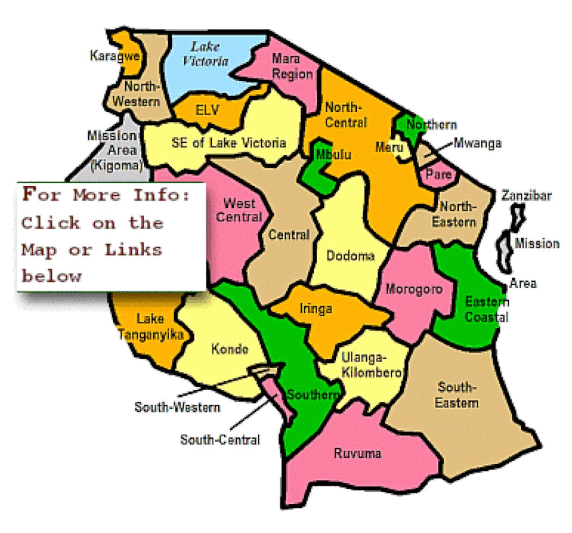
Pare Diocese on the ELCT map
This map shows all twenty seven dioceses of the Evangelical Lutheran Church in Tanzania. Pare Diocese serves the Upare area, in Same and Mwanga districts of Kilimanjaro Region. A dedicated map of the diocese's own parishes will be added once prepared by the diocesan office.
National partnerships
Organisations supporting the wider work of the ELCT
These organisations partner with the Evangelical Lutheran Church in Tanzania at the national level. Any partnerships specific to Pare Diocese will be listed here once confirmed by the diocesan office.






Part one
The history of the Evangelical Lutheran Church in Tanzania
The foundation from which every diocese, including Pare, grew.
1887
The Berlin III Missionary Society, also known as the Evangelical Missionary Society for East Africa, sent the first Lutheran missionaries from Germany, opening a mission station at Kigamboni in Dar es Salaam.
1891 - 1910
The Berlin I mission entered from South Africa and settled in the Southern Highlands. Berlin III became the Bethel Mission and later opened a station in Bukoba, Kagera Region, in 1910.
1893
The Leipzig Mission Society entered Tanzania and opened its first station at Kidia, Old Moshi, in the Kilimanjaro region, close to where Pare Diocese now stands.
1938
Seven independent Lutheran churches in Tanganyika, grown from decades of mission work through the Hehe War, the Majimaji War and two World Wars, formed the Federation of Lutheran Churches in Tanganyika.
19 June 1963
The seven churches united into synods and dioceses of a single church, the Evangelical Lutheran Church in Tanganyika, later renamed the Evangelical Lutheran Church in Tanzania after union with Zanzibar.
Today
The church has grown to 27 dioceses, including Pare Diocese, together with joint institutions such as Tumaini University Makumira, Lutheran Junior Seminary Morogoro, and more than 170 hospitals and health centres nationwide.
Part two
The history of Pare Diocese
Diocese-specific history, prepared for official details from the diocesan office.
Awaiting official diocesan history
This section is reserved for the specific founding history of Pare Diocese: the year of establishment, the parent diocese or synod it emerged from, the first and current Bishops, and the early parishes that formed the diocese. It will be completed once the diocesan office provides these details.
Establishment year
To be confirmed
First Bishop
To be confirmed
Founding parishes
To be confirmed
Current Bishop
To be confirmed
What guides us
Vision, mission and the focus of our work
Vision
A communion of people rejoicing in love and peace, blessed spiritually and physically, hoping to inherit eternal life through Jesus Christ.
Mission
To enable people to know Jesus Christ and have life in its fullness by bringing them the Good News through words and deeds, founded on the Word of God and Lutheran teaching, guided by the ELCT Constitution.
Church Focus
Propagating the holistic Gospel, serving humanity spiritually, socially, economically and environmentally, to build a God-loving community across every diocese.
Our foundation
Core values that shape our life together
Five convictions anchor the witness of every congregation and ministry across the diocese.
Love
Love for God and neighbour as the root of every ministry and relationship.
Matthew 22:37-39
Prayerfulness
A life of prayer that shapes decisions, worship and daily service.
Mark 11:24
Accountability
Faithful stewardship of trust placed in the church and its leaders.
1 Corinthians 4:1-2
Unity
One body across many congregations, districts and generations.
John 17:21
Dignity
Honouring every person as bearer of God's image, in justice and compassion.
Amos 5:24
Continue exploring